Showing posts with label African-American. Show all posts

February 9, 2010

Renee Stout is David C. Driskell Prize Winner

Artdaily.org - The First Art Newspaper on the Net: "
High Museum of Art Names Artist Renee Stout as David C. Driskell Prize Winner


Renee Stout's mixed-media works examine the impact of the African Diaspora and the traditions of her African heritage. Photo: Mary Noble Ours.

Visit Stout's web site at http://www.reneestout.com/

ATLANTA, GA.- The High Museum of Art has named artist Renee Stout as the 2010 recipient of the David C. Driskell Prize. Named after the renowned African American artist and art scholar, the Driskell Prize is an annual award that recognizes a scholar or artist in the beginning or middle of his or her career whose work makes an original and important contribution to the field of African American art or art history. Based in Washington , D.C. , Stout works in a variety of media including photography, sculpture, painting, drawing and printmaking. As the sixth Driskell award recipient, Stout will be honored at the Driskell Prize Dinner in Atlanta on Monday, April 19, 2010.

“Renee Stout is a visual artist fully incorporating every available resource to create works relevant to both past and present,” said Michael E. Shapiro, Nancy and Holcombe T. Green, Jr. Director of the High. “Her ability to draw upon the implications of the African Diaspora and highlight African culture through her imaginative and distinctive art exemplifies the qualities of a David C. Driskell Prize recipient. We are pleased to support her vision and development through this award.”

Stout’s mixed-media works examine the impact of the African Diaspora and the traditions of her African heritage as well as the themes of self-exploration, empowerment and healing. Using a variety of media and visual languages—including African aesthetics and secondhand materials—Stout pieces together narratives that tie history to contemporary society.


Traveling Root Store #2 (Madam Ching Goes High Tech)
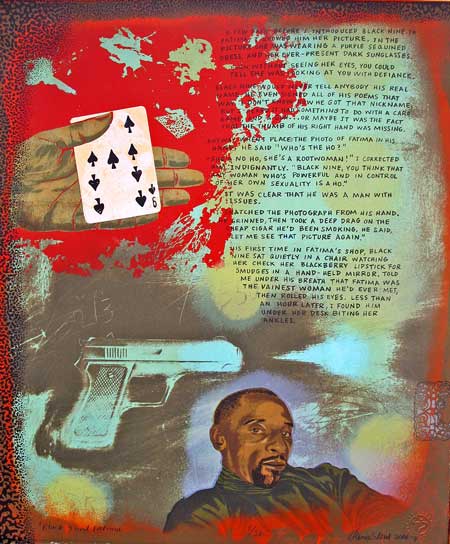
Imaginary characters recur in Stout’s work, adding whimsy and humor to the challenging and often depressing subject matter. The character Madame Ching appears in many works, including the 1993 piece “Traveling Root Store #2: Madame Ching Goes High Tech,” in which Stout pits a vintage doctor’s bag, vials and herbs against Madame Ching’s new-age custom computer. The keyboard on the computer is altered to Madame Ching’s needs, with various buttons being replaced to assist her in reaching deities. Also present in many works is Stout’s alter-ego Fatima Mayfield. “Fatima Mayfield, a fictitious herbalist/fortuneteller, is the vehicle that allows me to role-play in order to confront the issues, whether it’s romantic relationships, social ills or financial woes, in a way that’s open, creative and humorous,” said Stout.


Renee Stout received a Bachelor of Fine Arts degree from Carnegie Mellon University in 1980 before moving to Washington , D.C. , where she began to study her African American heritage, the wellspring of her subsequent work and career. As an arts advocate, Stout served on the panel of the DC Commission on the Arts and Humanities as well as George Washington University’s panel “Art School, Confidential: Rethinking Art Education.” In 1999 she won the Anonymous Was a Woman award and her second Pollock-Krasner Foundation award. Recent awards and recognition include the Joan Mitchell Painters and Sculptors Grant and a fellowship as the first artist-in-residence at Johns Hopkins University (2009). Throughout her career, Stout’s participation in numerous solo and group exhibitions has been met with international success. She currently lives and works in Washington , D.C.

The selection process for the 2010 recipient of the Driskell Prize began with a call for nominations from a national pool of artists, curators, teachers, collectors and art historians. The final winner was chosen from these nominations by review-committee members Richard Powell, John Spencer Bassett Professor of Art History, Duke University ; Jacquelyn D. Serwer, Chief Curator, National Museum of African American History and Culture, Smithsonian Institution; and Michael Rooks, Wieland Family Curator of Modern and Contemporary Art, High Museum of Art, Atlanta.


            Fatima and Black 9 (2007)

Share/Save/Bookmark

November 24, 2009

Deborah Willis and Carrie Mae Weems talk about beauty

from Cnylink Local News:

Nov 24

Nancy Keefe Rhodes 11/24/09More articles


Deborah Willis’ new book, ‘Posing Beauty,’ uses Ken Ramsay’s 1970s-era portrait of Susan Taylor for the cover.


“Where are you going next?” I asked Deborah Willis, who sat at the end of a table piled with copies of half a dozen of her 27 books in the hallway at Light Work Gallery.


“Well tomorrow I’m going to Paris for a signing and then after that to Zurich for another book event,” she smiled. All the copies of Willis’ two new books – “Posing Beauty: African American Images from the 1890s to the Present” and a slender volume centering on Michelle Obama, which she later said she’d had to agree to do as part of a package deal to get the beauty book a publisher – had sold out.


In the hallway before the talk, under Willis’ hands on the table’s edge sat a single copy of her book with Carla Williams, “The Black Female Body: A Photographic History” (2002). It’s out of print now and the few hard-to-come-by copies on-line are collector-grade pricey. The SU Bookstore was managing the book table sales and had pulled out what other Willis volumes they had on hand for this signing event, which was how this single stray copy of “The Black Female Body” had surfaced. Willis herself quickly bought it and then called Williams on her cell to report she’d found a copy: even Williams hadn’t had one, which made me feel not so bad I’d gotten there too late.


Willis – premier photohistorian, writer, curator, Chair of Imaging at NYU’s Tisch School of the Arts, MacArthur “genius” fellow, and art photographer (she has a joint photo exhibition with her son, Hank Willis Thomas, “Progeny,” touring nationally through 2010) – travels a lot. The artist and photographer Carrie Mae Weems says she has never encountered anyone with a matching work ethic. The two are very old friends and last Thursday night they sat together before a packed audience in the auditorium off Light Work Gallery and talked at length about Black beauty and how that is represented in photography, something both have wrestled with and written about and made images of for years now, and ranged as well into how work really starts in the classroom with students’ questions and how Michelle Obama – once cast as fist-bumping terrorist – has changed things. The Willis-Weems talk was the final event in the Central New York Mellon Humanities Corridor’s “Key Words in Visual Culture,” a semester-long project carried on jointly among Syracuse University, the University of Rochester and Cornell.


Carrie Mae Weems was recently featured on PBS’ Artists in the 21st Century series and herself has work in the Getty Museum, the International Center of Photography and MoMA. She said Thursday that she had known Willis over 30 years.


“When I was starting out, I put out a call to find women who were working around the country – Black women in photography – Deb was one of the first who replied,” she said.


Willis was in town last year right after the presidential election at the invitation of the Southside Initiative, consulting about creating community history projects. She gave an afternoon talk at the Dunbar Center, showing slides and commenting on some of the early black-and-white photos of local photographer Marjory Wilkins. Later that day she spoke on campus, introduced by Weems, and showed slides from the beauty project, which she’d just then sent off to the publisher. She said she wished she’d seen Wilkins’ images before she’d finished the book, fastening particularly on one of a young man arm-in-arm with two well-dressed ladies and another of five young women posing before a plate-glass window after church. She again showed slides Thursday night, beginning with a 1850 poster for a runaway slave named Dolly, whom her owner so wanted back that he acknowledged publically that she was “rather good looking.”


Willis has been researching her new book actively for over a decade, seeking out images from the 1890s to the present that document how both photographers and their subjects have defined, challenged and reinvented concepts of beauty for women and men in African-American communities, how a “pose” is constructed (as well as how images actively “pose” – as in, to offer or assert – certain visual traits as beautiful) and the ways that beauty is essentially empowering. But her engagement with these questions dates from her childhood when she “watched the transformation women experienced in my mother’s beauty shop in our home in North Philadelphia,” and from her years as an undergraduate student who’d just started working at the Schomberg Center in Harlem and noticed there seemed to be very little material on Black beauty. Criss-crossing the country since then, getting a second masters in art history, she found there turned out to be a lot more material than she’d thought. She is looking always for stories, she says.


At 234 pages, “Posing Beauty” has a compact introduction that asks about both sides of the photographic interaction – what the photographer and what the subject each sought; how the Black community went about making its own store of images to counter the sea of mainstream hostile, stereotypical images in the U.S.; and references Elaine Scarry’s astute and thoughtful “On Beauty and being Just” (2001), the best working-out that I know about how we recognize the beautiful and the sources of our urge to reproduce that – to make images. The book also has a detailed index, a bibliography, end-notes – but mostly it has pages and pages of images, both men and women, and to sit with it for even a little while is to see why Publisher’s Weekly calls it “ground-breaking.”


These are divided into four sections, each of which contains wonderful surprises. Early in “Constructing a Pose,” there’s a snapshot of the musician Valaida Snow, a musician caught in a Nazi dragnet in World War II Europe who died in a concentration camp; here, she’s conducting a small orchestra during a show in London in 1934, dressed in a shimmering, slinky white gown, baton raised. There is the image of Zora Neale Hurston by Carl Van Vechten that she liked because it made her “look mean and impressive.” There’s also Cartier-Bresson’s “Easter Sunday Morning, Harlem, 1947” and Theodore Fonville Winans’ “Dixie Belles, Central Louisiana, 1938” – two girls in straw hats placed just so – and Eve Arnold’s “Malcolm X, Chicago, 1961” (also on the book’s back cover) and Bruce Davidson’s “Bodybuilder on Venice Beach, 1964,” one of the slides Willis showed last Thursday with a droll comment about the woman in the picture taking the bodybuilder’s picture while her husband looked on, helpless, hands jammed in his pockets. Some of the images in “Posing Beauty” have appeared already in “The Black Body” and it’s a pleasure to see they will have a new lease of life in this new book.


The second section is titled “Body and Image” and features a range of images that actively assert “beauty” and the power it confers – a 1930s image entitled “Brown Madonna and Child,” Prentice Polk’s portrait of Lena Horne posing with the Tuskegee Airmen in the 1940s before a statue of George Washington Carver, Eve Arnold’s “Integration Crisis” – two schoolgirls side by side in a restroom, one Black, at a party to introduce students in Virginia in 1958.


Part III, “Modeling Beauty and Beauty Contests,” brings together a number of Willis projects, including photo-documentation of Black beauty parlors and barber shops, some from the 1920s, and her question to find visual records of Black beauty contests, the earliest of which occurred over a century ago. This section also contains images of men posing with jazzy new cars and women engaging in cultured pursuits such as the image of a Black woman giving piano lessons to a young girl that W.E.B. DuBois took the Paris Exposition in 1899 as part of his project to present African Americans in radically new visual settings. And here is Jurgen Schadberg’s 1955 shot of the singer Miriam Makeba in a Johannesburg nightclub with her natural hair, which Willis has spoken of as having an electrifying effecting in those years. Part IV comprises a number of color plates, from portraits of public figures to the increasing use of self-portraiture such as RenĂ©e Cox perched in the Statue of Liberty’s crown.


Light Work videotaped the talk that Willis and Weems had so that may be available at some point. Meanwhile, there’s “Posing Beauty,” worth the wait.


Nancy covers the arts. Reach her at nancykeeferhodes@gmail.com.
"
Share/Save/Bookmark

November 14, 2009

Black Action Heroes

Noctuary: a record of what passes in the night: Black Action Heroes: "

Black Action Heroes

Attended a conversation between artist/photographer Hank Willis Thomas (my super-fuzzy photo of him signing copies of Pitch Blackness, at left. Check the Johns Hopkins link below for a much better look at him!) and at the Baltimore Museum of Art last night -- and also attempted my first Live Tweet from the event as well! Visual artists fascinate me, how they turn ideas into images, how they 'speak' in colors and textures. Thomas has been in residence at Johns Hopkins this semester, and the discussion was very good. Some quotes from the evening I found/find particularly fecund, like his use of 'appropriated' images from advertising and considers himself a 'visual culture archivist' when doing so because 'certain things can only be said by re-presenting them...how do I make this (ready-made) image my own?'

'I didn't realize I really wanted to BE an artist until after going through ten years of art school. Up to then I was just figuring stuff out.'

And my favorite line of the evening: If he were stranded on a desert island 'I would make art out of sand. Sand is infinite...'

As a poet of course I was particularly fascinated by his explication of the 'I Am A Man' series, based on the famous placards from the 1968 Memphis Sanitation Strike -- and how it should be read. I mentioned after the talk that I had read the texts first image upper left, next image lower left, back up to the second image on the first line...up and down all the way across. He presented them from to right across the first line as a history of the way blacks have been looked at (3/5 of a man, are we men?, Ain't I a Woman coming into the picture with the rise of the Woman's movemnt, etc) with the second row of texts, some of the popular riffs on that text, like 'I Am The Man' or 'What A Man') 'reading like a poem.' The final image 'I Am. AMEN.' ends the work with a statement of how we all want to be seen.

One of Thomas' projects, on display in Baltimore until the end of November is 'Winter in America' a short film he did in collaboration with Kambui Olujimi uses GI Joes to dramatize the murder of his cousin Songha Thomas Willis in 2000 (can be seen by clicking 'The Film' under the 'Winter in America' link on his website). It is disturbing, sad, powerful, and very moving, and does indeed make you think about the role violent 'play' might have in real violence.

Henry Willis Thomas will be doing one more event before he leaves Baltimore, a Community Salon where he'll discuss his participation in the Artist-in-Residence Program at the Johns Hopkins on Saturday, November 14, 2009 (3:00 – 5:00 pm) at Galerie Myrtis (2224 N. Charles St). Those in the area should try not to miss it.


read more at:  Noctuary: a record of what passes in the night


Share/Save/Bookmark

Harlem drawings serve as snapshot of black culture

Harlem drawings serve as snapshot of black culture:

By Jessica Shim
8:37 AM on 11/13/2009

From the barbershop down the block, to African hair braiders setting up shop on the street corner, artist Wardell Milan presents a personal view of Harlem in a series of sketches.

'I live here in Harlem,' said Milan. 'I've really come to love not only the neighborhood but just the different people and the different activities and events that happen in Harlem.'

It's a love that has culminated into the newest exhibit on display at the Studio Museum in Harlem. The museum has served as an outlet and advocate for African-American artists since 1968.
'We're always incredibly focused on Harlem,' said the Studio Museum's assistant curator Naomi Beckwith. 'Whether that be very physically and very literally, as in this show which shows works done in Harlem and about Harlem. But also we like to think of Harlem as a sort of metaphor for black culture globally altogether.'

An alumni of the studio museum's artist-in-residence program, Milan was invited back to develop this exhibit. The sketches are from photos he would take on walks through this neighborhood.'You know I would walk around Harlem at 8:00 in the morning to photograph,' said Milan. 'And then I would walk around at 10:00 at night and it was always just kinetic energy that kind of was just flowing through the neighborhood.'

'I would say Harlem first of all is really the capital of Black America and some would say maybe the black world,' said Beckwith. 'Everyone understands Harlem as a place that is almost mythical.' Harlem's long-standing reputation of being the forefront of black culture means there's always something happening and changing.

'What Wardell's show really connects to is that sort of legacy of people documenting this ever changing community that both represents a kind of mythology in a black world, but also has a long long visual history throughout the whole life of this nation and city.'


Follow theGrio on Facebook & Twitter!

"
Share/Save/Bookmark

the cloud

9/11 (2) Abbema_Jelte van (1) action heros (2) Afghanistan (1) Africa (1) African-American (4) Akakce_Haluk (1) Amorales_Carolos (1) Anderson_Pam (1) Anger_Kenneth (1) animation (1) anime (1) Arab (1) Arata_Michael (1) archaeology (1) architecture (2) Arranz-Bravo_Eduardo (1) art_market (1) avant garde (2) Aztatlan culture (1) Baier_Nicolas (1) Bailey-Beezy (1) Baldessari_John (1) Ballard_ J.G. (1) Balthus-Greg (1) Banerjee_ Sunandini (1) baroque (1) Bataille (1) beauty (1) Bell_Jonathan (1) Beloff_Zoe (1) Bergman_Robert (1) Black Atlantic (1) Bottero_Fernando (1) Burton_Time (1) C Magazine (1) Cai Guo-Qiang (1) Caravaggio (1) Castillo_Victor (1) Castro-Kelley (1) China (4) Christie's (1) Coching_Francisco (1) collage (1) Collins_Phil (1) comics (5) conceptual art (1) Condo_George (1) consumer_culture (1) cultural capital (1) culture_hacking (1) Cumberland_Sturart (1) Dali_Zhang (1) darklorddisco (1) Darwin (1) Davis-Stuart (1) death (1) Der Blaue Reite (1) design (1) digital (4) Dikovitskaya_Margaret (1) dolls (1) drawing (2) drawings (1) Dzama_Marcel (1) eco_culture (1) EcoMag (1) Eggleston_William (1) Egypt (2) El-Siwi_Adel (1) Emberley_Ed (1) Ethiopia (1) ethnography (1) Fairey_Shepard (1) Falnama (1) Fauxreel (1) feminist (6) film (12) film_score (1) Flickr (1) FlowTV (1) Folkert (1) food (2) Ford-Michael Lee (1) Fosik-AJ (1) Fournier_Marie (1) Furedi-Lily (1) gaphic design (1) gender (3) Genesis Beyer P-Orridge (1) Gentry_Nick (1) Germany (1) Giacometti_Alberto (1) global culture (1) Goltzius_ Hendrick (1) Gordon_Douglas (2) graffiti (2) graphic (9) graphic design (6) Gysis-Nicholaos (1) Harlem (1) Harris-Charles "Teenie" (1) Hass-Philip (1) Hirschhorn_Thomas (1) Hirst_Damien (1) history (1) Hitchcock (1) Hman_Jonathan (1) Holzer_Jenny (1) Hopper_Edward (1) Hulk-the Incredible (1) illustrated manuscripts (1) illustration (1) images (1) impressionism (1) India (3) Indonesia (1) installation (9) intersex (1) Iranian (2) Jalali_Bahman (1) Japan (2) Jongeleen_Jeroen (1) Kakebeeke_Karijn (1) Kandinsky_Wassily (1) KAWS (1) Kiefer_Anselm (1) Koelbl-Herlinde (1) Kritkos (1) Kuniyoshi_Utagawa (1) Lady GaGa (1) Landy_Michael (1) Latin America (2) Levin-Golan (1) Lewis_Ben (1) Lewis_Dave (1) Lewis_Wyndham (1) Linder_Richard (1) lithographs (1) low brow (2) Lozano_Lee (1) Macleod_Steve (1) Macphee_Graham (1) Manga (1) Marly-Pierre (1) Marvel Comics (1) Matta Clark_ Gordon (1) Maya (1) McCullin_Don (1) Meckseper_Josephine (1) media (1) medieval (1) Metrick-Chen_Lenore (1) Mexico (1) minimalism (1) Miss Van (1) modernism (1) Mooi Indie (1) Mottalini_Chris (1) Mueck_Ron (1) Murakami_Takashi (1) Museum of Contemporary Art (1) music animation (1) Muybridge_Eadwearch (1) network culture (1) new media (1) Obama (1) oil (1) Olav_Westphalen (1) Ortiz-Santiago (1) painting (28) Panton_Verner (1) paparazzi (1) Paranormal Activity (1) pep art (1) Philippine (1) photography (36) photoshop (2) Pilson_John (1) Pollock_Jackson (1) pop art (18) Portuguese (1) prints (1) Provost_Nicolas (1) public art (1) punk (1) Quinto_Felice (1) ready-made (1) recycling (1) recyled art (1) religion (1) Richardson-Earle (1) Richter_Gerhard (1) Roehr_Peter (1) Romantic art (1) Rostovsky_Peter (1) Rudolph_Paul (1) Ruff_Thomas (1) ruins (1) Russia (1) sculpture (2) seriality (1) Shaden-Brooke (2) Shonibare-Yinka (2) Singh Twins (1) Smith_Kiki (1) Sotheby (1) sound (1) Soviet style art (1) Spain (1) Spanish (1) story telling (1) Stout_Renee (1) street art (1) Suerkemper_Caro (1) Superman (1) Suriname (1) Swerman_Marshalll (1) tattoos (1) Te Wei (1) technology (1) territoriality (1) text (1) Thomas_Harnk Willis (1) Titian (1) Tolan_Canan (1) Tomic-Milica (1) Tommy Ga-Ken Wan (1) Turkey (1) TV (1) Twombly_Cy (1) ubran screens (1) vanities (1) Vertigo (1) Victorian (1) video (6) Violette_Banks (1) visuality (8) waste (1) weddings (1) Wessel-Henry (1) White-Charles (1) wiki (1) Wikipedia (1) Willardson_David (1) Wilson_Jane (1) Winterling_Sussane (1) work (1) Zeid_Fahrelnissa (1) Zero Art (1)

search this blog

Superfamous is the studio of interaction designer Folkert Gorter, primarily engaged in graphic and interactive design with a focus on networks and communities. Folkert holds a Master of Arts in Interactive Multimedia and Interaction Design from the Utrecht School of Art, faculty Art, Media & Technology, The Netherlands. He lives in Los Angeles, California."

Click on any text below to see Folkert's remarkable posts from the blog "but does it float."

but does it float