All Hallows’ Sheaves
October 30th, 2009 by Sean Rogers in Four-Colour Words Comment »
Happy Halloween, once again, one and all! This year I ask that we consider some choice old horror anthologies, in whose pages lurk all sorts of scares and shocks. The horror tradition in comics has long been dominated by a model developed by the EC comics company in the 1950s, whose titles like Tales from the Crypt featured cornball “hosts” (the Cryptkeeper and his ilk), pun-filled narration, surprise twist endings (the werewolf was his brother!), wide-eyed bigfoot cartooning, and endless! exclamation! points! I admire EC and its murderer’s row of artists as much as the next comics reader, but our attentions now turn to those collections that worry the boundaries of the EC-style anthology, or pounce outside of them altogether.

 In 1962, late in his career, kiddie comics master John Stanley briefly turned his hand to the horror genre. The indispensable Stanley Stories blog has lately been posting his strips from Ghost Stories and Tales from the Tomb in their entirety. The typically incisive commentary over there covers much of what I would want to say about these, frankly, kind-of-insane comics, so I urge you to click through.
I’d like to emphasize, though, just how much Stanley got away with, thanks to working under the aegis of Dell Comics, the innocuous, kids-only publisher of titles like Donald Duck, Little Lulu, and Fairy Tale Parade — atypical fare for the gore-and-guts set. Dell’s spotless G-rated record allowed it to publish beyond the censorial eye of the Comics Code Authority, who in the mid-’50s had neutered or foreclosed upon bloodthirsty troublemakers like EC and its imitators. Stanley’s first stabs at horror were allowed to revel in threats of dismemberment, ghastly suicide, child-killing monsters, parents devoured by malevolent forces, and a scissors-wielding grandma who wants to knit you.
 These ghost stories are another order of spooky altogether, the kind that confounds expectation, logic, and often comprehension. Stanley’s uncredited collaborators stiffly delineate these dreamlike tales, and though the results are sometimes crude, they are always very far from inept. Underlying every panel and every page is Stanley’s visual sophistication, which grants even the most wooden or unpracticed renditions the stark and primal quality of nightmare.
When we break through the muddle of the story to those final, gigantic panels, the effect is authentically startling, if absurd. We come forcibly out of the tale as though we’re waking up in a cold sweat, breathless, puzzled as to what our fevered brains have conjured up. Like, the psychiatrist’s head is a quilt?

 Six issues of Skull appeared between 1970 and 1972. Gary Arlington, proprietor of the renowned San Francisco Comic Book Company, came up with the bare bones idea for a horror anthology in the EC tradition; artist Greg Irons fleshed it out, and underground comics had another addition to its onslaught of horror books. Most of Skull featured the grim crosshatching grotesquerie of Irons and Jack Jackson, as well as the first UG work from the smooth and heavy metal-friendly pen of Richard Corben, among others. Some less out-and-out examples of the genre formed part of the scene, too, though I’m less familiar with them, having only caught the barest glimpses of Slow Death, or Insect Fear or, most tantalisingly, the gruesome cute brut of Rory Hayes’s Bogeyman (send in your unwanted copies c/o The Walrus).
Skull is worth singling out if only because it distinguished itself, late in the series, by taking EC’s literary aspirations and turning them inside out. So where EC’s go-to pulp auteur was the square and kind of respectable Ray Bradbury, the Skull crew gave over two entire issues to groovy, eldritch H.P. Lovecraft adaptations. True, the influence of Lovecraft and his Cthulhu Mythos in literary horror has been as pervasive and maybe pernicious as EC’s in comics. At the time of the undergrounds, though, horror comics had as yet been been unmolested by the man’s tentacles, so an infusion of the Old Ones into the genre could at least boast the virtue of novelty. And at best, transposing Lovecraft to this setting helped connect with the UG’s flair for depicting goings-on in extremis (hence Michael Smith’s flesh-melting psychedelic freak-out in “Cool Air”). The gleeful, de trop stylings of many of the artists match well with Lovecraft’s squelching purple prose (”a nightmare caked and clotted with bloody shreds of alien flesh and hair, embraced by a malignant retinue of sleeping bats”).
In Skull’s final issue, the full-length “A Gothic Tale,” Irons and Corben — the twin poles of slick and dirty UG professionalism — took turns illustrating writer Tom Veitch’s centuries-spanning Lovecraftian story of mad science, gross monstrosity, and weird old religion. It’s a fine capstone to an interesting series, one of those fully conceived, self-contained little packages of which the underground was sometimes impressively capable.

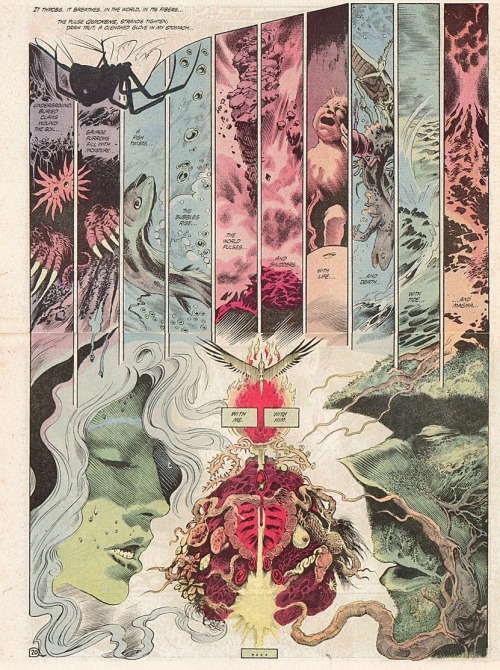
 In the 1980s, having helped redefine monster comics as part of the all-star Swamp Thing team (who, if you’re wondering, had nothing to do with the film), artist Steve Bissette had yet further services to perform in his favoured genre. Determined to continue setting an example for seriousness in horror comics, rather than uphold the cheesy old punch-pulling norm, Bissette cofounded and edited a series called Taboo. The books were thick tomes rather than floppy pamphlets, whose bold conception was on occasion actually matched by the capabilities of their contributors. Taboo’s publication history is fascinating and convoluted and depressing, tied as it is to the various industry implosions of the time. The result of this tortuous past is that the series is a record of projects interrupted, delayed, or left unfinished. Alan Moore and Eddie Campbell’s Jack the Ripper saga From Hell concluded elsewhere, for instance, as did both the Moore-written porno epic Lost Girls and Jeff Nicholson’s Through the Habitrails, a sort of anti-Dilbert.
But the real one that got away was Throat Sprockets, an amalgam of not-quite-vampires and not-quite-snuff-films from Video Watchdog mastermind Tim Lucas. He completed the tale in prose novel form, but it’s forever to be regretted that his working relationship with initial artist Mike Hoffman fell through. Hoffman’s angular photorealism evinced a real feel for the sharpness and seediness of well-worn film prints, and Lucas proved remarkably adept at splicing and manipulating the language of comics.
Beyond this impressive array of halting serials, an above-average number of Taboo’s highlights arrived in isolated contributions. There were some very pretty stand-alone stories from neo-pre-Raphaelite Michael Zulli, including a jaw-dropper written by Neil Gaiman’s then-five-year-old daughter (Gaiman and Zulli’s take on Sweeney Todd is another Taboo-fostered project that screeched to a skidding stop). Chester Brown wrung an unsettling amount of pathos out of funny animals falling prey to the food chain. Al Columbia, standard-bearer of modern-day horror comics, contributed some vivid, frenzied outpourings. What continues to haunt me, though, are a handful of candidates for career-best work from underground legend S. Clay Wilson: his graphic and sweaty and desperate “This is Dynamite” in particular strikes me as truly taboo, so relentlessly did his penlines scratch away at deep human ugliness.
We could’ve used another couple dozen volumes of horror comics under Bissette’s stewardship, especially as the years have worn on and the talent pool has gotten deeper and darker, allowing for an easier skimming off of the dross. Imagine a thick regular instalment of something like Taboo, where Renee French’s soft-penciled parables of death and deformity, or Josh Simmons’s claustrophobic wrongness, or Columbia’s cartoon apocalypses, all rub scabby shoulders. Ah well, such dreams are for Halloweens yet to come.

"
* * *

 In 1962, late in his career, kiddie comics master John Stanley briefly turned his hand to the horror genre. The indispensable Stanley Stories blog has lately been posting his strips from Ghost Stories and Tales from the Tomb in their entirety. The typically incisive commentary over there covers much of what I would want to say about these, frankly, kind-of-insane comics, so I urge you to click through.
I’d like to emphasize, though, just how much Stanley got away with, thanks to working under the aegis of Dell Comics, the innocuous, kids-only publisher of titles like Donald Duck, Little Lulu, and Fairy Tale Parade — atypical fare for the gore-and-guts set. Dell’s spotless G-rated record allowed it to publish beyond the censorial eye of the Comics Code Authority, who in the mid-’50s had neutered or foreclosed upon bloodthirsty troublemakers like EC and its imitators. Stanley’s first stabs at horror were allowed to revel in threats of dismemberment, ghastly suicide, child-killing monsters, parents devoured by malevolent forces, and a scissors-wielding grandma who wants to knit you.
 These ghost stories are another order of spooky altogether, the kind that confounds expectation, logic, and often comprehension. Stanley’s uncredited collaborators stiffly delineate these dreamlike tales, and though the results are sometimes crude, they are always very far from inept. Underlying every panel and every page is Stanley’s visual sophistication, which grants even the most wooden or unpracticed renditions the stark and primal quality of nightmare.
When we break through the muddle of the story to those final, gigantic panels, the effect is authentically startling, if absurd. We come forcibly out of the tale as though we’re waking up in a cold sweat, breathless, puzzled as to what our fevered brains have conjured up. Like, the psychiatrist’s head is a quilt?
* * *

 Six issues of Skull appeared between 1970 and 1972. Gary Arlington, proprietor of the renowned San Francisco Comic Book Company, came up with the bare bones idea for a horror anthology in the EC tradition; artist Greg Irons fleshed it out, and underground comics had another addition to its onslaught of horror books. Most of Skull featured the grim crosshatching grotesquerie of Irons and Jack Jackson, as well as the first UG work from the smooth and heavy metal-friendly pen of Richard Corben, among others. Some less out-and-out examples of the genre formed part of the scene, too, though I’m less familiar with them, having only caught the barest glimpses of Slow Death, or Insect Fear or, most tantalisingly, the gruesome cute brut of Rory Hayes’s Bogeyman (send in your unwanted copies c/o The Walrus).
Skull is worth singling out if only because it distinguished itself, late in the series, by taking EC’s literary aspirations and turning them inside out. So where EC’s go-to pulp auteur was the square and kind of respectable Ray Bradbury, the Skull crew gave over two entire issues to groovy, eldritch H.P. Lovecraft adaptations. True, the influence of Lovecraft and his Cthulhu Mythos in literary horror has been as pervasive and maybe pernicious as EC’s in comics. At the time of the undergrounds, though, horror comics had as yet been been unmolested by the man’s tentacles, so an infusion of the Old Ones into the genre could at least boast the virtue of novelty. And at best, transposing Lovecraft to this setting helped connect with the UG’s flair for depicting goings-on in extremis (hence Michael Smith’s flesh-melting psychedelic freak-out in “Cool Air”). The gleeful, de trop stylings of many of the artists match well with Lovecraft’s squelching purple prose (”a nightmare caked and clotted with bloody shreds of alien flesh and hair, embraced by a malignant retinue of sleeping bats”).
In Skull’s final issue, the full-length “A Gothic Tale,” Irons and Corben — the twin poles of slick and dirty UG professionalism — took turns illustrating writer Tom Veitch’s centuries-spanning Lovecraftian story of mad science, gross monstrosity, and weird old religion. It’s a fine capstone to an interesting series, one of those fully conceived, self-contained little packages of which the underground was sometimes impressively capable.
* * *

 In the 1980s, having helped redefine monster comics as part of the all-star Swamp Thing team (who, if you’re wondering, had nothing to do with the film), artist Steve Bissette had yet further services to perform in his favoured genre. Determined to continue setting an example for seriousness in horror comics, rather than uphold the cheesy old punch-pulling norm, Bissette cofounded and edited a series called Taboo. The books were thick tomes rather than floppy pamphlets, whose bold conception was on occasion actually matched by the capabilities of their contributors. Taboo’s publication history is fascinating and convoluted and depressing, tied as it is to the various industry implosions of the time. The result of this tortuous past is that the series is a record of projects interrupted, delayed, or left unfinished. Alan Moore and Eddie Campbell’s Jack the Ripper saga From Hell concluded elsewhere, for instance, as did both the Moore-written porno epic Lost Girls and Jeff Nicholson’s Through the Habitrails, a sort of anti-Dilbert.
But the real one that got away was Throat Sprockets, an amalgam of not-quite-vampires and not-quite-snuff-films from Video Watchdog mastermind Tim Lucas. He completed the tale in prose novel form, but it’s forever to be regretted that his working relationship with initial artist Mike Hoffman fell through. Hoffman’s angular photorealism evinced a real feel for the sharpness and seediness of well-worn film prints, and Lucas proved remarkably adept at splicing and manipulating the language of comics.
Beyond this impressive array of halting serials, an above-average number of Taboo’s highlights arrived in isolated contributions. There were some very pretty stand-alone stories from neo-pre-Raphaelite Michael Zulli, including a jaw-dropper written by Neil Gaiman’s then-five-year-old daughter (Gaiman and Zulli’s take on Sweeney Todd is another Taboo-fostered project that screeched to a skidding stop). Chester Brown wrung an unsettling amount of pathos out of funny animals falling prey to the food chain. Al Columbia, standard-bearer of modern-day horror comics, contributed some vivid, frenzied outpourings. What continues to haunt me, though, are a handful of candidates for career-best work from underground legend S. Clay Wilson: his graphic and sweaty and desperate “This is Dynamite” in particular strikes me as truly taboo, so relentlessly did his penlines scratch away at deep human ugliness.
We could’ve used another couple dozen volumes of horror comics under Bissette’s stewardship, especially as the years have worn on and the talent pool has gotten deeper and darker, allowing for an easier skimming off of the dross. Imagine a thick regular instalment of something like Taboo, where Renee French’s soft-penciled parables of death and deformity, or Josh Simmons’s claustrophobic wrongness, or Columbia’s cartoon apocalypses, all rub scabby shoulders. Ah well, such dreams are for Halloweens yet to come.
* * *
Finally, in subject matter worlds away from this post: Saturday’s spate of IFOA XXX events includes my interview with Seth, whom I’ve gone on about before, and R.O. Blechman, whose far-reaching career making perfect little drawings should provide much to talk about. Details are here. Toronto readers, I’ll see you at noon in Harbourfront’s Brigantine Room.


_01_20.jpg)
_01_54.jpg)